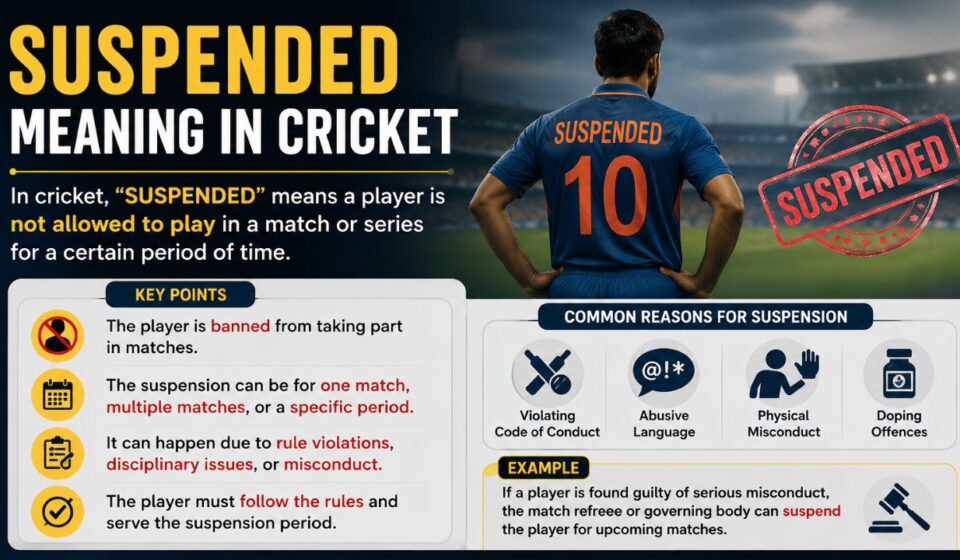

You’re watching a nail-biting T20 match. Your team needs 12 runs off the last two overs. The bowler is at the top of his run-up. And then — out of nowhere — the umpires start pulling stumps, the covers come on, and your TV screen flashes two dreaded words: Match Suspended.
Your heart sinks. Your group chat explodes. And someone — there’s always someone — asks: “But what does suspended actually mean? Is the match over?”
After exploring cricket’s rulebook deeply and researching countless real-world examples, I’m here to give you the clearest, most complete breakdown of the suspended meaning in cricket. No jargon, no confusion — just everything you actually need to know.
“Suspended” vs “Abandoned” vs “No Result” — These Are NOT the Same Thing
Before anything else, let’s clear up the biggest confusion I’ve noticed among cricket fans.
These three terms sound similar but mean very different things:
| Term | Meaning | Can the Match Resume? | Is a Result Possible? |
| Suspended | Temporary pause in play | Yes | Yes (if minimum overs met) |
| Abandoned | Match called off entirely | No | No |
| No Result | Minimum overs not completed | No (match is over) | No — points shared |
| Interrupted | Any break in play (broad term) | Usually yes | Depends |
So when you see the suspended meaning in cricket, remember this — it’s a pause, not an ending. The match is still live. The scorecard stays intact. Players go back to the dressing room, ground staff roll out the covers, and everyone waits.
In my experience, this is the single most misunderstood term in cricket broadcasting. Commentators throw it around casually, but most viewers don’t realise how much it actually determines what happens next.
The Real Definition: Suspended Meaning in Cricket, Explained Simply
A suspension in cricket is when the on-field umpires officially halt play due to conditions that make it unsafe or unfair to continue.
The key word here is unsafe. Umpires are not stopping the match because they feel like it — they’re doing it because continuing would either risk player safety or compromise the fairness of the contest.
The authority for this decision comes from two places:
- The MCC Laws of Cricket (the governing body for cricket’s laws globally)
- ICC Playing Conditions for international matches
Under these rules, umpires have full authority to suspend play immediately if they judge conditions to be dangerous or unreasonable. No player, captain, or team management can override this call. The decision is entirely theirs.
This is what makes the suspended meaning in cricket so significant — it’s not a procedural delay. It’s an official, rule-backed action with real consequences for the game.
6 Real Reasons a Cricket Match Gets Suspended
After researching this deeply, I found that suspensions happen for far more reasons than just rain. Here’s a complete breakdown:
1. Rain (The Most Common Culprit)
Rain makes the pitch slippery, the outfield dangerous, and the ball wet — all of which create unfair and unsafe playing conditions. Rain is behind the vast majority of suspensions in cricket, especially in England, Sri Lanka, and India during the monsoon season.
2. Bad Light
In Test cricket especially, fading light is a serious concern — particularly for batters facing fast bowlers. When the light drops below a safe threshold, umpires suspend play. Modern grounds use light meters to make objective decisions rather than relying on guesswork.
3. Dangerous Pitch or Outfield
If the pitch develops dangerous cracks, becomes waterlogged, or the outfield is slippery enough to cause injuries while fielding, officials can suspend the match. Player safety always comes first, even if the sky is perfectly clear.
4. Crowd Disturbances
This one surprises many fans. However, crowd trouble has caused real suspensions in the past. A classic example is the 1996 World Cup semi-final at Eden Gardens in Kolkata, where crowd disturbances forced the umpires to halt play entirely.
5. External Incidents (Animals, Floodlights, etc.)
I’ve personally watched matches get briefly stopped because a bird or snake wandered onto the field. Floodlight failures are another legitimate reason for a suspension — if visibility suddenly drops, the umpires act fast.
6. Global Events or Security Concerns
During the COVID-19 pandemic in 2021, the IPL was temporarily suspended after multiple players and support staff tested positive. More recently in 2025, IPL matches were shifted and rescheduled due to security concerns following regional tensions — the Punjab Kings vs Delhi Capitals game in Dharamsala being a notable example.
What Actually Happens When a Match Gets Suspended?
So the match is suspended. Now what?
Here’s exactly what unfolds, step by step:
Step 1 — Players Leave the Field The umpires signal the suspension, players immediately walk off. The match is paused but not cancelled.
Step 2 — Ground Staff Move In Covers are rolled onto the pitch and square to protect the playing surface. This is a well-drilled operation at top venues — teams of ground staff can have a full cover on within minutes.
Step 3 — Officials Monitor Conditions Umpires continuously assess the weather, pitch condition, and visibility. They don’t need anyone’s permission to restart — that call is entirely theirs.
Step 4 — The Clock Becomes Critical Every format has cut-off times. In limited-overs cricket, minimum overs must be completed before a result can be declared. In T20 matches, typically 5 overs per side are needed. In ODIs, it’s usually 20 overs per team. If these minimums can’t be met before the cut-off, the match heads toward a No Result or abandonment.
Step 5 — DLS Kicks In (If Needed) If overs are lost due to the suspension and the match does resume with a reduced format, the Duckworth–Lewis–Stern (DLS) method recalculates the target. More on this below.
Step 6 — Reserve Day (In Major Tournaments) ICC events like the World Cup and Champions Trophy schedule reserve days for knockout matches. The India vs New Zealand 2019 World Cup semi-final is the most famous example — persistent rain forced the match onto the reserve day, which ultimately altered the entire momentum of the contest.
The DLS Method: Cricket’s Rain-Math That Everyone Loves to Argue About
No discussion of the suspended match meaning in cricket is complete without explaining DLS.
The Duckworth–Lewis–Stern method is a mathematical formula that recalculates a fair target for the chasing team when overs are lost due to suspension. It factors in two resources: overs remaining and wickets in hand.
Here’s a simple way to understand it:
- A team with 10 wickets and 20 overs left has more resources than a team with 5 wickets and 20 overs
- DLS compares these resources between both teams at the point of interruption
- It then sets a revised target that reflects a fair competition given those resources
The par score concept is important here too. If rain arrives during the second innings, the batting team’s current score is compared to the DLS par — if they’re ahead of par and the match can’t resume, they win.
One thing I noticed in my research that surprises many fans: DLS is not applied the moment rain starts. Officials only use it when the time lost becomes permanent and overs must actually be reduced. A brief suspension that allows full restart changes nothing.
Moreover, DLS has been independently verified and updated multiple times by ICC statisticians. Despite what frustrated fans say after their team loses under DLS, the system is far more scientific than “random.”
Suspended Match Meaning in Cricket Across Formats
The suspended match meaning in cricket plays out differently depending on the format:
| Format | Minimum Overs for Result | Reserve Day? | DLS Applied? |
| Test Match | N/A (5 days of play) | No | No |
| ODI (50-over) | 20 overs per team | Sometimes (tournaments) | Yes |
| T20 | 5 overs per team | Yes (knockout stages) | Yes |
| IPL | 5 overs per team | Yes (finals) | Yes |
In Test cricket, a suspension rarely causes a major problem — there are five full days of play, and even rain-affected Test matches can produce results. However, bad light suspensions in Test cricket are famously frustrating, particularly in England.
In T20 and ODI cricket, the suspended match meaning in cricket carries far more immediate pressure. Teams and fans know that every minute of delay brings the cut-off time closer.
For IPL specifically, the rules go one step further in knockout matches. If even the reserve day can’t produce a result, the game moves to a Super Over. And if weather prevents even that, the team that finished higher in the league stage advances. Therefore, a suspension in an IPL final is genuinely high-stakes for both teams.
Famous Real-World Examples of Match Suspension
India vs New Zealand — 2019 World Cup Semi-Final (Manchester) One of the most heartbreaking suspended matches in recent memory. Rain wiped out most of Day 1, and the match was carried over to the reserve day. New Zealand ultimately won, knocking India out. The suspension dramatically altered the momentum of the entire contest.
India vs New Zealand — 2019 World Cup (Trent Bridge, Group Stage) This one was abandoned entirely without a ball bowled. The two unbeaten teams shared a point each — a result that had genuine implications for the group standings.
India vs Pakistan — Asia Cup, Colombo Heavy storms in Colombo halted this iconic rivalry fixture, forcing reliance on the reserve day. Whenever India and Pakistan play during monsoon season, the suspended match meaning in cricket becomes painfully real for fans on both sides.
IPL 2021 — Full Tournament Suspension The most dramatic suspension in IPL history. Multiple COVID-19 cases within team bubbles forced the BCCI to pause the entire tournament mid-season. It was eventually completed in the UAE later that year.
1996 World Cup Semi-Final, Kolkata Crowd trouble — not weather — caused the suspension and eventual abandonment of this Sri Lanka vs India clash. It remains one of cricket’s most chaotic moments.
5 Myths About Match Suspension — Busted
Myth 1: “Rain always means No Result” False. Rain causes suspension, not automatic abandonment. As long as minimum overs can be completed before the cut-off, a result is still possible — often on the same day.
Myth 2: “DLS is unfair and random” DLS follows a validated mathematical model updated regularly by ICC statisticians. Criticism usually comes from misunderstanding how resource percentages work.
Myth 3: “The match restarts exactly from the same moment” Scores and wickets are preserved, yes. However, the ball may be replaced and overs may be reduced after an extended suspension.
Myth 4: “Players can ask for the match to be suspended” No. Only the on-field umpires have this authority. Players, captains, or team management cannot demand a suspension — though they can raise safety concerns with the umpires.
Myth 5: “Suspension means the match is over” Absolutely not. Suspension is a pause. The match remains live and a result is very much possible.
FAQs: Suspended Meaning in Cricket
Q1. What is the suspended meaning in cricket in simple words?
A suspension in cricket is when umpires officially pause the match due to unsafe or unfair conditions — such as rain, bad light, or pitch problems. It’s a temporary halt, not a cancellation. The match remains live and can resume.
Q2. What is the suspended match meaning in cricket for the IPL?
In IPL league matches, if the match can’t resume in time to meet the minimum 5-over threshold, it’s declared a No Result and points are shared. In knockout matches, a reserve day is used. If that’s also insufficient, the higher-ranked team in the standings advances.
Q3. Does DLS apply the moment a match is suspended?
No. DLS is only applied when time loss becomes permanent and the over count must be reduced. A brief suspension that allows full resumption changes nothing.
Q4. Can players request a suspension?
No. Only on-field umpires can officially suspend play. However, players can raise safety concerns with the umpires.
Q5. What happens to player statistics during a suspended match?
All statistics remain on the scorecard exactly as they were when play stopped. Records and scores are fully preserved throughout the suspension period.
Q6. What’s the difference between a suspended match and an abandoned match?
A suspended match is paused with resumption expected. An abandoned match is permanently called off with no further play possible. A suspended match can still produce a result; an abandoned match cannot.
Q7. What is the suspended match meaning in cricket for Test matches?
In Tests, suspensions are handled differently because there are five days of play available. Bad light or rain causes a temporary halt, and play resumes when conditions improve. Test matches are not subject to DLS.
Final Thoughts: Suspension Is Cricket’s Way of Fighting Back
Here’s what I think most fans miss about the suspended meaning in cricket — it’s actually a feature, not a flaw.
Cricket is the only major sport where weather can genuinely change the outcome of a match. Suspension rules, DLS, reserve days, and minimum-over thresholds are all part of cricket’s remarkable ability to adapt and still deliver a fair result under imperfect conditions.
Meanwhile, the drama that comes with a suspension — the covers going on, the rain hammering the outfield, the players peering anxiously from the dressing room window — is uniquely cricket. No other sport has this tension.
So the next time you see “Match Suspended” flash across your screen, don’t panic. Don’t assume the worst. Instead, understand that the umpires are doing exactly what they should — protecting players, protecting fairness, and giving the match every chance to produce a proper result.
Because in cricket, the game isn’t over until it truly is.