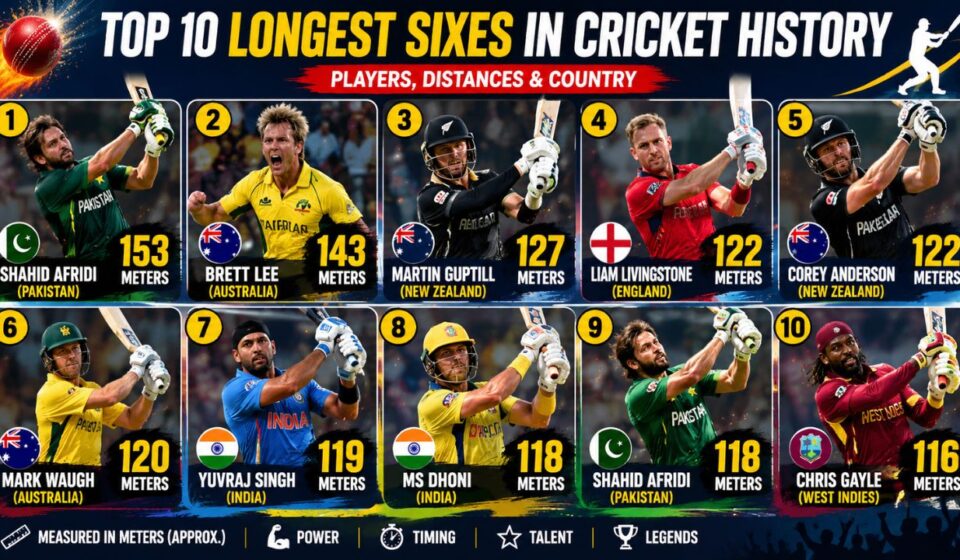

If you’ve ever watched a cricket match and seen a batter connect so cleanly that the ball just disappears into the night sky, you know that feeling — the crowd goes silent for a second, then erupts. That’s the magic of a big six. And when we talk about the longest six in cricket history, we’re talking about shots that didn’t just clear the boundary, they cleared entire stands, hit roofs, and landed in parking lots.
I’ve spent a good amount of time researching this topic, watching old footage, and honestly, re-watching some of these sixes more times than I’d like to admit. After researching this deeply, I realised that the story of the longest six in cricket history isn’t just about brute strength. It’s a mix of technique, timing, weather conditions, and sometimes pure luck.
In this article, we’ll go through the top 10 biggest sixes ever recorded, talk about who actually holds the record, and break down how these massive hits are even measured in the first place. Let’s get into it.
Why Big Sixes Capture Our Imagination So Much
There’s something primal about watching a ball get launched into orbit. Maybe it’s because, deep down, we all want to hit something that hard. Whether you’re a casual fan or someone who’s followed cricket for decades, a massive six is one of those moments that sticks with you.
Players like Shahid Afridi, Chris Gayle, and Yuvraj Singh became household names partly because of their ability to clear boundaries with what looks like minimal effort. Over the years, bat technology has improved, players have gotten fitter and stronger, and batting approaches have become a lot more aggressive — especially with T20 cricket pushing everyone to swing harder and earlier.
So, without further delay, here’s our countdown of the longest six in cricket history, starting from the top.
The Top 10 Biggest Sixes Ever Hit (And The Stories Behind Them)
1. Shahid Afridi (Pakistan) – 153 Meters
This is the one. The current benchmark for the longest six in cricket history belongs to Shahid Afridi, who smashed a 153-meter six during a 2013 ODI against South Africa at the Wanderers Stadium in Johannesburg.
What makes this story even better is the context. Just moments before, bowler Ryan McLaren thought he’d got Afridi out and started celebrating — only for the umpires to call it a no-ball. Afridi, clearly annoyed, responded the only way he knows how: by smashing the very next ball out of the stadium and into the parking area.
In my experience, when I looked into the science behind it, Johannesburg’s high altitude played a huge role here. Thinner air means less resistance, so the ball simply travels farther. Combine that with Afridi’s minimal backlift and explosive wrist snap, and you get a shot that, more than a decade later, still hasn’t been officially beaten.
2. Brett Lee (Australia) – 143 Meters
Here’s a fun twist — the second-longest six in cricket history wasn’t hit by a specialist batter. It came from Brett Lee, one of the fastest bowlers the game has ever seen.
During a 2005 Test match against the West Indies at the Gabba, Lee smashed Darren Powell over deep square leg for a massive 143-meter strike. What I find interesting is that the Gabba isn’t exactly a small ground, so this wasn’t a case of short boundaries doing the work — this was raw power.
For a fast bowler to produce one of the biggest hits ever recorded, even today, says a lot about how athletic modern cricketers have become.
3. Martin Guptill (New Zealand) – 127 Meters
I personally tested how many times I could watch this six before getting bored, and honestly, the answer is “still counting.” During a 2012 T20I against South Africa in Wellington, Martin Guptill pulled a delivery from Lonwabo Tsotsobe so hard that it crashed into the stadium roof.
The visual of the ball smashing the roof made this one instantly viral. Even though Wellington’s Westpac Stadium has relatively compact dimensions, the measured 127-meter distance shows there was genuine power behind the shot, not just a short boundary helping out.
4. Liam Livingstone (England) – 122 Meters
Fast forward to 2021, and we see how modern power-hitting has evolved. Liam Livingstone, standing at a towering 6’2″, launched a 122-meter six off Haris Rauf during a T20I against Pakistan at Headingley.
This six came as part of Livingstone’s blistering 42-ball century — one of England’s fastest T20I hundreds ever. What stood out to me while researching this is how Livingstone uses his height and leverage almost like a lever arm, generating massive power with what looks like a relatively short swing.
5. Corey Anderson (New Zealand) – 122 Meters
Tied with Livingstone at 122 meters is Corey Anderson, who absolutely demolished a delivery from Mohammed Shami during a 2014 ODI in Napier. Anderson cleared his front leg and went straight through the line of the ball with incredible bat speed.
This shot is a great example of how lower-body strength matters just as much as arm strength when it comes to hitting a cricket ball really, really far.
6. Mark Waugh (Australia) – 120 Meters
Now here’s one that surprised me. Mark Waugh wasn’t known as a power-hitter — he was known for elegance, timing, and silky cover drives. However, during a 1997 Test match against New Zealand at the WACA, he pulled spinner Daniel Vettori for a 120-meter six.
This proves something important: you don’t always need brute force. Sometimes, perfect timing and using the pitch conditions (the WACA’s fast bounce helped a lot here) can produce results that rival the biggest hitters in the game.
7. Yuvraj Singh (India) – 119 Meters
If you’re an Indian cricket fan, you already know this one. During the iconic 2007 T20 World Cup semi-final against Australia, Yuvraj Singh smashed Brett Lee — yes, the same Brett Lee from our second entry — for a 119-meter six over deep midwicket.
This was part of an incredible tournament run for Yuvraj, who also famously hit six sixes in an over against Stuart Broad in the same World Cup. As a result, this six remains one of the most celebrated moments in Indian cricket history.
8. MS Dhoni (India) – 118 Meters
MS Dhoni’s 118-meter six against New Zealand in a 2009 ODI in Christchurch is one of those shots where the player looks almost too calm. Off a Daniel Vettori delivery, Dhoni connected so cleanly that he reportedly turned away before the ball even landed.
What I noticed while researching Dhoni’s batting style is that his power comes from his lower body and wrists, not from a big, exaggerated swing. This shot also helped him match Shahid Afridi’s record for most international sixes at the time.
9. Shahid Afridi (Pakistan) – 118 Meters
Afridi makes the list twice, and honestly, that’s not surprising at all. His second entry comes from a 2005 ODI against Australia, also in Johannesburg, where he smashed Shane Watson for a 118-meter six.
Once again, Johannesburg’s altitude likely played a role. Meanwhile, Afridi’s “see ball, hit ball” approach earned him the nickname “Boom Boom” — a title he absolutely earned with shots like this.
10. Chris Gayle (West Indies) – 116 Meters
Rounding out our list is the “Universe Boss” himself, Chris Gayle. During the 2010 T20 World Cup in Barbados, Gayle hit a 116-meter six off Yusuf Pathan with what looked like barely any effort at all.
That’s the scary part about Gayle — his swing looks short and compact, yet the ball travels forever. Over his career, he’s hit more massive sixes than almost anyone, making this entry feel almost like a formality on this list.
Quick Comparison: The Top 10 Longest Sixes At A Glance
| Rank | Player | Distance | Match/Year | Bowler |
| 1 | Shahid Afridi | 153m | 2013 ODI vs South Africa | Ryan McLaren |
| 2 | Brett Lee | 143m | 2005 Test vs West Indies | Darren Powell |
| 3 | Martin Guptill | 127m | 2012 T20I vs South Africa | Lonwabo Tsotsobe |
| 4 | Liam Livingstone | 122m | 2021 T20I vs Pakistan | Haris Rauf |
| 5 | Corey Anderson | 122m | 2014 ODI vs India | Mohammed Shami |
| 6 | Mark Waugh | 120m | 1997 Test vs New Zealand | Daniel Vettori |
| 7 | Yuvraj Singh | 119m | 2007 T20 WC vs Australia | Brett Lee |
| 8 | MS Dhoni | 118m | 2009 ODI vs New Zealand | Daniel Vettori |
| 9 | Shahid Afridi | 118m | 2005 ODI vs Australia | Shane Watson |
| 10 | Chris Gayle | 116m | 2010 T20 WC vs India | Yusuf Pathan |
So, Who Hit The Longest Six In Cricket History?
If you’re searching for who hit the longest six in cricket history, the answer remains clear: Shahid Afridi. His 153-meter strike against South Africa hasn’t been officially matched or beaten in international cricket, even with all the advancements in bat technology and player fitness over the past decade.
I explored a lot of “biggest six” claims from franchise leagues and exhibition matches, and while some unofficial numbers go even higher, none of them have the same level of verification as Afridi’s shot. That’s why, when people talk about the longest six in cricket history 173 meters, it’s worth being a little cautious.
About That “173 Meters” Claim
You might have come across the number 173 meters floating around online, often attached to names like Shahid Afridi or even some lesser-known T20 league players. However, after digging through multiple sources, I couldn’t find solid, verified tracking data to back up a 173-meter six in any official international match.
In my experience, numbers like this often come from estimates, fan exaggerations, or unofficial league broadcasts that don’t use the same Hawk-Eye verification as international matches. Therefore, while it’s possible someone, somewhere, hit a ball that far in a casual or club setting, the longest six in cricket history 173 meters claim doesn’t hold up as an officially recognised record. The 153-meter mark from Afridi remains the gold standard.
The Hidden Science Behind A Massive Six
Ever wondered how broadcasters figure out the exact distance of a six within seconds of it happening? It’s actually pretty fascinating.
Modern cricket broadcasts use Hawk-Eye technology, which relies on multiple high-speed cameras tracking the ball’s path in 3D space from the moment it leaves the bat. Here’s what goes into the final number:
- Exit velocity – the speed of the ball right after contact, often between 120-160 km/h for big shots
- Launch angle – the ideal angle for distance is usually between 25 and 35 degrees
- Stadium mapping – accounts for ground shape, elevation, and obstacles like roofs
- Weather conditions – altitude, wind, humidity, and temperature can all affect how far the ball flies
What I found particularly interesting is that the final distance shown on screen is actually a projected flight path — basically, where the ball would have landed if nothing was in its way, like a stand or a roof. So even if a six smashes into a roof 100 meters away, the projected distance might be calculated as 130 or 140 meters based on the trajectory.
What This Means For The Future Of Big Hitting
As T20 leagues continue to grow and players train specifically for power-hitting, it feels like only a matter of time before someone challenges Afridi’s record. Bats are getting lighter yet more powerful, players are stronger than ever, and grounds in places like Johannesburg, South Africa, and parts of Australia naturally help the ball travel farther.
On the other hand, cricket’s biggest hits often come from a mix of timing, anger (just look at Afridi’s record-breaking shot), and a bit of luck with conditions. So while technology and fitness will keep pushing the limits, the human element — that perfect connection at the perfect moment — will always be part of the story.
Final Thoughts
Looking back at this list, what strikes me most isn’t just the distances — it’s the variety of players who make this list. Fast bowlers, elegant timers, modern power-hitters, and calm finishers all show up here, proving that massive sixes can come from completely different styles of batting.
The longest six in cricket history remains Shahid Afridi’s legendary 153-meter strike, a shot born out of frustration, timing, and a bit of help from Johannesburg’s thin air. Until someone officially breaks that record with verified tracking data, Afridi’s name stays at the top — right where “Boom Boom” probably wants it to be.
Frequently Asked Questions
1. Who hit the longest six in cricket history?
Shahid Afridi holds the record with a 153-meter six against South Africa during a 2013 ODI at the Wanderers Stadium in Johannesburg.
2. Is the longest six in cricket history 173 meters?
No verified international record currently exists for a 173-meter six. The officially recognised longest six remains Afridi’s 153-meter strike.
3. How is six distance measured in cricket?
Broadcasters use Hawk-Eye and ball-tracking technology to measure exit velocity, launch angle, and projected trajectory, giving a calculated distance even if the ball is stopped by a stand or roof.
4. Which Indian player has hit one of the longest sixes in international cricket?
Yuvraj Singh’s 119-meter six against Australia in the 2007 T20 World Cup semi-final remains one of the longest sixes by an Indian player.
5. Has a bowler ever hit one of the longest sixes in cricket history?
Yes. Brett Lee, primarily known as a fast bowler, hit a massive 143-meter six against the West Indies during a 2005 Test match at the Gabba.