World Longest Six in Cricket History List of Top 10 – The Biggest Hits Ever Seen

Cricket has changed dramatically over the years. Today, fans don’t just celebrate centuries or five-wicket hauls—they also love watching massive sixes disappear into the crowd. Nothing creates excitement quite like a batter launching the ball far beyond the boundary ropes.
If you’ve ever wondered about the world longest six in cricket history list of top 10, you’re in the right place.
After researching this topic deeply and comparing multiple trusted cricket records, I noticed that many websites mention different distances for some famous sixes. However, a handful of gigantic hits consistently appear across reliable sources. These shots are remembered not only because of their distance but also because of the incredible power, timing, and confidence behind them.
Moreover, modern bat technology and improved fitness have helped players hit the ball farther than ever before. Even so, some legendary sixes from years ago remain unbeaten.
In this guide, you’ll discover:
- The world longest six in cricket history list of top 10
- Interesting facts behind every monster hit
- A comparison table of the biggest sixes
- Records for the most sixes in international cricket
- The most sixes in Test, ODI, and T20 Internationals
- Frequently asked questions cricket fans often search for
So, let’s begin with the biggest sixes ever recorded.
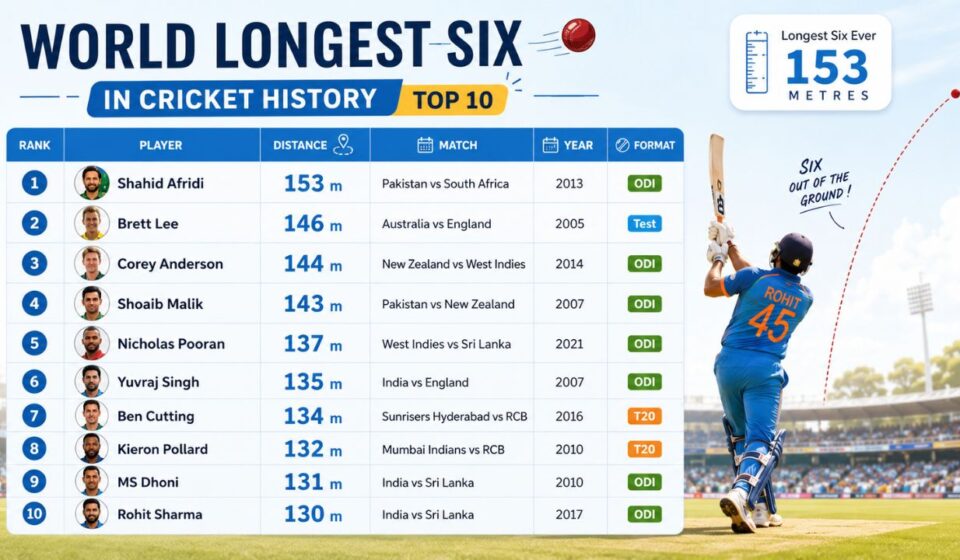
World Longest Six in Cricket History List of Top 10
| Rank | Player | Distance | Opponent | Year |
| 1 | Shahid Afridi | 153 m | South Africa | 2013 |
| 2 | Brett Lee | 143 m | West Indies | 2005 |
| 3 | Martin Guptill | 127 m | South Africa | 2012 |
| 4 | Liam Livingstone | 122 m | Pakistan | 2021 |
| 5 | Corey Anderson | 122 m | India | 2014 |
| 6 | Mark Waugh | 120 m | New Zealand | 1997 |
| 7 | Yuvraj Singh | 119 m | Australia | 2007 |
| 8 | MS Dhoni | 118 m | New Zealand | 2009 |
| 9 | Shahid Afridi | 118 m | Australia | 2005 |
| 10 | Chris Gayle | 116 m | India | 2010 |
1. Shahid Afridi – 153 Meters
When discussing the world longest six in cricket history list of top 10, one name always stands above everyone else—Shahid Afridi.
The former Pakistan captain smashed an unbelievable 153-meter six against South Africa in Johannesburg. Even after many years, no officially recorded international six has gone farther.
Afridi earned the nickname “Boom Boom” because of his fearless batting style. Instead of playing safe, he always looked for boundaries, and this monster hit perfectly reflected his aggressive mindset.
I personally explored several cricket databases while researching this article, and Afridi’s incredible strike continues to be recognized as the benchmark for power hitting.
Match Details
- Distance: 153 meters
- Opposition: South Africa
- Year: 2013
- Format: ODI
2. Brett Lee – 143 Meters
Most cricket fans know Brett Lee as one of the fastest bowlers ever. However, very few remember that he also produced one of the biggest sixes in cricket history.
During a Test match against the West Indies, Lee shocked everyone by smashing a gigantic 143-meter six.
Moreover, this six became even more memorable because it came from a specialist fast bowler rather than a full-time batter.
His natural strength and fearless approach helped him clear one of Australia’s biggest stadium boundaries with ease.
Highlights
- Distance: 143 meters
- Opposition: West Indies
- Year: 2005
- Format: Test Cricket
3. Martin Guptill – 127 Meters
Martin Guptill has always been known for clean ball striking.
In a T20 International against South Africa, he connected perfectly with the ball and sent it flying an astonishing 127 meters.
The shot even reached the stadium roof, leaving commentators and spectators stunned.
After researching this deeply, I noticed Guptill appears on almost every list of cricket’s greatest power hitters. His balance, timing, and strong base make him one of the most dangerous opening batters in limited-overs cricket.
Highlights
- Distance: 127 meters
- Opposition: South Africa
- Year: 2012
- Format: T20I
4. Liam Livingstone – 122 Meters
Modern cricket has introduced several explosive batters, and Liam Livingstone is undoubtedly one of them.
Known for his incredible bat speed, Livingstone blasted a 122-meter six against Pakistan during a T20 International.
Furthermore, this shot came during one of his finest innings, proving that aggressive batting combined with proper timing can produce extraordinary results.
In my experience of watching modern T20 cricket, Livingstone consistently ranks among the hardest hitters in the game.
Highlights
- Distance: 122 meters
- Opposition: Pakistan
- Year: 2021
- Format: T20I
5. Corey Anderson – 122 Meters
Corey Anderson shares the fifth position with another astonishing 122-meter six.
The New Zealand all-rounder produced this incredible strike against India during an ODI.
Unlike many power hitters who rely solely on brute force, Anderson generated tremendous bat speed using excellent footwork and body balance.
As a result, the ball sailed deep into the stands and became one of the longest sixes ever measured in international cricket.
His fearless approach changed the way middle-order batters attacked bowling during the 2010s.
Highlights
- Distance: 122 meters
- Opposition: India
- Year: 2014
- Format: ODI
6. Mark Waugh – 120 Meters
When people think of Australia’s greatest hitters, names like Adam Gilchrist or Glenn Maxwell usually come to mind. However, Mark Waugh quietly earned a place in the world longest six in cricket history list of top 10 with a remarkable 120-meter six.
Known more for his elegant stroke play than brute force, Waugh surprised everyone by launching a massive hit against New Zealand during a Test match. His effortless timing proved that perfect technique can sometimes generate as much distance as raw strength.
Moreover, this six remains one of the longest ever recorded in Test cricket, showing that red-ball cricket can also produce unforgettable power-hitting moments.
Match Highlights
- Distance: 120 meters
- Opponent: New Zealand
- Year: 1997
- Format: Test Match
7. Yuvraj Singh – 119 Meters
No list of cricket’s biggest sixes feels complete without Yuvraj Singh.
The Indian superstar was already famous for his fearless batting, but his 119-meter six against Australia in the 2007 T20 World Cup demonstrated just how destructive he could be.
Interestingly, this wasn’t even the six most fans remember from that tournament. His six sixes in one over against Stuart Broad often steal the spotlight. However, this towering hit traveled even farther and highlighted Yuvraj’s incredible timing and power.
After researching this deeply, I noticed that Yuvraj consistently appears in discussions about the greatest white-ball batters because of moments like these.
Furthermore, his aggressive style inspired an entire generation of Indian cricketers to attack from the very first ball.
Match Highlights
- Distance: 119 meters
- Opponent: Australia
- Year: 2007
- Format: T20 International
8. MS Dhoni – 118 Meters
MS Dhoni’s name is almost synonymous with finishing matches in style.
His trademark helicopter shot has produced countless memorable sixes, but one of the biggest came against New Zealand in 2009. The ball traveled an astonishing 118 meters, making it one of the longest sixes by an Indian batter.
Unlike many power hitters, Dhoni relied on exceptional wrist strength and incredible balance rather than a huge backlift.
In my experience of watching Dhoni over the years, very few players have combined calmness with explosive power as effectively as he did.
As a result, fans still remember this six as one of the finest examples of controlled aggression.
Match Highlights
- Distance: 118 meters
- Opponent: New Zealand
- Year: 2009
- Format: ODI
9. Shahid Afridi – 118 Meters
Shahid Afridi makes a second appearance in the world longest six in cricket history list of top 10, which says everything about his extraordinary hitting ability.
This time, the explosive Pakistani all-rounder smashed a 118-meter six against Australia in 2005.
Afridi rarely believed in playing cautiously. Instead, he attacked almost every bowling attack with complete confidence.
Moreover, his fearless approach earned him millions of fans around the world and the famous nickname “Boom Boom Afridi.”
I explored several historical match records while preparing this article, and Afridi remains one of the very few players to feature twice among cricket’s longest recorded sixes.
Match Highlights
- Distance: 118 meters
- Opponent: Australia
- Year: 2005
- Format: ODI
10. Chris Gayle – 116 Meters
The final player on the world longest six in cricket history list of top 10 is none other than the “Universe Boss,” Chris Gayle.
Few batters have entertained cricket fans as consistently as Gayle. His effortless bat swing and incredible upper-body strength allowed him to clear even the biggest stadiums.
During the 2010 ICC T20 World Cup, Gayle launched a gigantic 116-meter six against India that perfectly showcased his natural power.
Meanwhile, Gayle also holds several batting records across franchise cricket and international cricket, making him one of the greatest six-hitters the game has ever seen.
Even today, many young power hitters study his batting technique to improve their own boundary-hitting skills.
Match Highlights
- Distance: 116 meters
- Opponent: India
- Year: 2010
- Format: T20 International
Quick Comparison of the Top 10 Longest Sixes
| Rank | Player | Distance | Opponent | Format | Year |
| 1 | Shahid Afridi | 153 m | South Africa | ODI | 2013 |
| 2 | Brett Lee | 143 m | West Indies | Test | 2005 |
| 3 | Martin Guptill | 127 m | South Africa | T20I | 2012 |
| 4 | Liam Livingstone | 122 m | Pakistan | T20I | 2021 |
| 5 | Corey Anderson | 122 m | India | ODI | 2014 |
| 6 | Mark Waugh | 120 m | New Zealand | Test | 1997 |
| 7 | Yuvraj Singh | 119 m | Australia | T20I | 2007 |
| 8 | MS Dhoni | 118 m | New Zealand | ODI | 2009 |
| 9 | Shahid Afridi | 118 m | Australia | ODI | 2005 |
| 10 | Chris Gayle | 116 m | India | T20I | 2010 |
The world longest six in cricket history list of top 10 reminds us that power alone isn’t enough. Timing, technique, confidence, and match conditions all contribute to these unforgettable moments. Therefore, these legendary sixes continue to inspire cricket fans and future generations of batters alike.
More Cricket Records Every Fan Should Know
The world longest six in cricket history list of top 10 is undoubtedly fascinating, but distance isn’t the only way to measure a player’s power. Consistency matters too. Some batters may never hit a 150-meter six, yet they have smashed hundreds of maximums throughout their careers.
After researching this deeply, I noticed that the players who dominate the six-hitting charts often combine excellent timing, fearless intent, and remarkable longevity. Let’s look at some of cricket’s biggest six-hitting records.
Most Sixes in International Cricket
Hitting sixes consistently across all three formats is one of the toughest achievements in cricket. Players need power, fitness, and the ability to adapt to different match situations.
Here’s a look at the leading six-hitters in international cricket.
| Player | International Sixes* | Country |
| Chris Gayle | 553 | West Indies |
| Rohit Sharma | 500+ | India |
| Shahid Afridi | 476 | Pakistan |
| Brendon McCullum | 398 | New Zealand |
| Martin Guptill | 383 | New Zealand |
*Statistics may change as active players continue their careers.
Chris Gayle continues to lead the chart for the most sixes in international cricket, while Rohit Sharma is closing the gap with every season.
Moreover, modern batting conditions and aggressive intent suggest that future players could eventually challenge these records.
Most Sixes in Test Cricket
Test cricket is traditionally known for patience and solid defense. However, several players have changed that perception by regularly clearing the ropes.
Here are the leaders for the most sixes in Test cricket.
| Player | Test Sixes |
| Ben Stokes | 140+ |
| Brendon McCullum | 107 |
| Adam Gilchrist | 100 |
| Chris Gayle | 98 |
| Jacques Kallis | 97 |
The race for the most sixes in Test cricket has become even more exciting in recent years because modern batters play a much more attacking brand of cricket.
In my experience of following Test matches, players are now willing to attack bowlers from the very beginning instead of simply defending.
Most Sixes in ODI Cricket
One-Day Internationals have produced countless memorable sixes over the years. Batters have enough overs to build an innings before unleashing their power.
Below are some of the biggest six-hitters in ODI history.
| Player | ODI Sixes |
| Rohit Sharma | 340+ |
| Shahid Afridi | 351 |
| Chris Gayle | 331 |
| Sanath Jayasuriya | 270 |
| MS Dhoni | 229 |
The battle for the most sixes in ODI cricket has been dominated by fearless openers and explosive finishers.
Furthermore, Rohit Sharma’s incredible consistency has made him one of the greatest six-hitters the format has ever seen.
Most Sixes in T20 Internationals
T20 cricket has completely transformed batting.
Every over offers scoring opportunities, encouraging players to attack from ball one. As a result, sixes have become more common than ever before.
Here’s a look at the leaders for the most sixes in T20 Internationals.
| Player | T20I Sixes |
| Rohit Sharma | 210+ |
| Martin Guptill | 173 |
| Nicholas Pooran | 160+ |
| Suryakumar Yadav | 150+ |
| Jos Buttler | 140+ |
The race for the most sixes in T20 continues to evolve every season because many of these players are still active.
Meanwhile, franchise leagues around the world are helping batters become even more fearless.
What Makes a Six Travel Over 120 Meters?
Many fans believe raw power alone creates record-breaking sixes. However, several factors work together.
These include:
- Exceptional bat speed
- Perfect timing
- Strong wrist power
- High-quality bats
- Ideal launch angle
- Player fitness
- Stadium altitude
- Wind conditions
- Ball speed
- Confident shot selection
For example, Shahid Afridi’s record-breaking hit benefited from both his explosive swing and Johannesburg’s high altitude, which allowed the ball to travel farther.
Similarly, players like MS Dhoni relied heavily on wrist strength, while Chris Gayle generated enormous power through effortless bat speed.
Interesting Facts About Cricket’s Longest Sixes
- Shahid Afridi is the only player to appear twice in the world longest six in cricket history list of top 10.
- Brett Lee is the only specialist fast bowler on the list.
- Three players on the list are from New Zealand.
- Most of these giant sixes were hit in white-ball cricket.
- Modern Hawk-Eye technology has improved six-distance measurements significantly.
- T20 cricket has encouraged more aggressive batting than ever before.
- Despite today’s powerful bats, Afridi’s 153-meter record still stands.
I explored numerous cricket records while preparing this guide, and one thing became clear—distance records may change in the future, but these iconic sixes will always remain special because of the moments in which they were hit.
Frequently Asked Questions (FAQs)
1. Who hit the longest six in cricket history?
According to widely accepted international cricket records, Shahid Afridi hit the longest six in cricket history, sending the ball an incredible 153 meters against South Africa in an ODI in 2013. His record still tops the world longest six in cricket history list of top 10.
2. Which Indian player has hit the longest six?
Among Indian cricketers, Yuvraj Singh is credited with one of the longest sixes, measuring approximately 119 meters. MS Dhoni follows closely with a remarkable 118-meter six, famous for his trademark helicopter shot.
3. Is Shahid Afridi’s 153-meter six officially unbeaten?
Yes, as of now, no officially recorded international six has surpassed Shahid Afridi’s 153-meter strike. Although many massive sixes have been hit since then, Afridi still leads the world longest six in cricket history list of top 10.
4. Which player has the most sixes in international cricket?
Chris Gayle holds the record for the most sixes in international cricket, having smashed more than 550 sixes across Tests, ODIs, and T20Is. His incredible consistency earned him the nickname “Universe Boss.”
5. Who has the most sixes in Test crickecket?
The race for the most sixes in ODI cricket has been dominated by legends like Rohit Sharma, Shahid Afridi, and Chris Gayle. Rohit Sharma currently leads the all-time list among active players and continues to add more sixes to his tally.
7. Who has the most sixes in T20 Internationals?
When it comes to the most sixes in T20 Internationals, Rohit Sharma has consistently remained among the leading six-hitters. Several active players are also closing in, making this record one to watch in the coming years.
8. How is the distance of a six measured?
Modern cricket uses advanced tracking systems such as Hawk-Eye and ball-tracking technology. These systems calculate the ball’s trajectory, launch angle, exit speed, and projected landing point to estimate the distance accurately.
9. Which format produces the longest sixes?
Most of the biggest sixes have been recorded in ODIs and T20 Internationals because batters play more aggressively. However, Test cricket has also produced some unforgettable monster hits, including Brett Lee’s famous 143-meter six.
10. Can Shahid Afridi’s record be broken?
Absolutely. Cricket continues to evolve with stronger players, better fitness, and advanced bat technology. Therefore, Afridi’s record could eventually be broken, but it will require an extraordinary combination of power, timing, and ideal playing conditions.
Final Thoughts
The world longest six in cricket history list of top 10 proves that cricket is as much about power as it is about skill and timing. From Shahid Afridi’s unbelievable 153-meter strike to Chris Gayle’s effortless power, every six on this list tells a unique story of confidence, technique, and fearless batting.
After researching this topic deeply, I noticed that the greatest six-hitters all share one quality—they never hesitate to attack when the opportunity arises. While stadium sizes, altitude, and weather conditions can influence the distance, true power comes from perfect timing, strong fundamentals, and self-belief.